

Leopard Wrasse EXPERT ONLY
(Macropharyngodon meleagris)
Please Note: Due to variations within species, your item may not look identical to the image provided. Approximate size range may also vary between individual specimen.
Please Note: Due to variations within species, your item may not look identical to the image provided. Approximate size range may also vary between individual specimen.
Leopard Wrasse EXPERT ONLY
(Macropharyngodon meleagris)
Additional locales and sizes may be available!
Additional locales and sizes may be available! Email me when available

|

Quick Stats
Care Level
Expert Only
Temperament
Peaceful
Color Form
Black, Blue, Green, Orange, Red, Tan, White
Diet
Carnivore
Reef Compatible
Yes
Water Conditions
sg 1.020-1.025, 72-78° F, dKH 8-12, pH 8.1-8.4
Max. Size
6"
Family
Labridae
Minimum Tank Size
90 gallons
Compatibility
View Chart
What do these Quick Stats mean? Click here for more information
Care Level
Expert Only
Temperament
Peaceful
Color Form
Black, Blue, Green, Orange, Red, Tan, White
Diet
Carnivore
Reef Compatible
Yes
Water Conditions
sg 1.020-1.025, 72-78° F, dKH 8-12, pH 8.1-8.4
Max. Size
6"
Family
Labridae
Minimum Tank Size
90 gallons
Compatibility
View Chart
What do these Quick Stats mean? Click here for more information
Overview
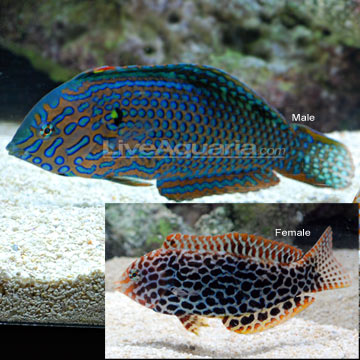
The Leopard Wrasse is also known as the Guinea Fowl Wrasse, or Blackspotted Wrasse. This species has two different appearances depending on gender. Females are white with multiple black or brown irregular spots with white to blue margins covering the entire body. The female's fins may have accents of yellow or tan. The males have an orangish-red background color with green mottling covering the body.
A 90 gallon or larger aquarium with well established live rock and a layer of live sand is recommended. They will do best when introduced in groups of three or more. It eats small invertebrates (foraminiferans and amphiopods) that grow on live rock.
The Leopard Wrasse diet should include vitamin enriched frozen mysis shrimp, vitamin enriched frozen brine shrimp, and other meaty foods along with a high quality marine flake and marine pellet food.<
Approximate Purchase Size: Small: 1/2" to 1-1/4"; Medium: 1-1/4" to 2-1/4"; Large: 2-1/4" to 3-1/2"
|
Please note: We guarantee that ALL aquaria species we offer will arrive alive and in good condition. However, because of the increased level of care required for this particular species, it has been designated as "Expert Only." This species is recommended only for the expert aquarist, zoo, or research institution. “Expert Only” aquatic life is exempt from our extended guarantee after their arrival. |
Supplies You May Be Interested In
More Aquatic Life


.jpg)
Customer Testimonials
Ashton Nietzke
Oakland Township , MI
A very peaceful fish. Mine was in a 180 gallon tank. They love to burrow into the substrate. Eventually they will even eat flake food like mine. Buy one today!
1-1 of 1 testimonials
LiveAquaria Education Center

