

Flameback Angelfish
(Centropyge acanthops)
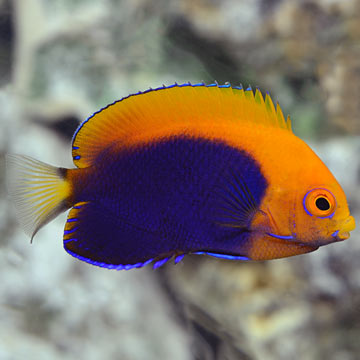
Please Note: Due to variations within species, your item may not look identical to the image provided. Approximate size range may also vary between individual specimen.
Please Note: Due to variations within species, your item may not look identical to the image provided. Approximate size range may also vary between individual specimen.

Flameback Angelfish
(Centropyge acanthops)
Additional locales and sizes may be available!
Additional locales and sizes may be available! Email me when available

|

Quick Stats
Care Level
Moderate
Temperament
Semi-aggressive
Color Form
Blue, Orange
Diet
Omnivore
Reef Compatible
With Caution
Water Conditions
sg 1.020-1.025, 72-78° F, dKH 8-12, pH 8.1-8.4
Max. Size
3"
Family
Pomacanthidae
Minimum Tank Size
55 gallons
Compatibility
View Chart
What do these Quick Stats mean? Click here for more information
Care Level
Moderate
Temperament
Semi-aggressive
Color Form
Blue, Orange
Diet
Omnivore
Reef Compatible
With Caution
Water Conditions
sg 1.020-1.025, 72-78° F, dKH 8-12, pH 8.1-8.4
Max. Size
3"
Family
Pomacanthidae
Minimum Tank Size
55 gallons
Compatibility
View Chart
What do these Quick Stats mean? Click here for more information
Overview
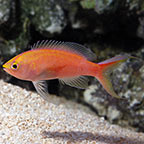
The Flameback Angelfish, also known as the African Pygmy Angelfish or Orangeback Angelfish, has striking contrasts of blue and orange-yellow colors. While the body is predominately blue, there is a broad and bright orange to yellow swatch from the head along the back to the tip of the dorsal fin. The caudal fin is yellow and somewhat transparent, which distinguishes it from the Brazilian Flameback Angelfish (also known as the Fireball Angelfish - Centropyge aurantonotus).
The Flameback Angelfish requires a minimum of a 55 gallon tank with lots of hiding places and live rock for grazing. On occasion, this fish may nip at SPS and some species of polyp corals in the reef aquarium.
The diet of the Flameback Angelfish should include Spirulina, marine algae, high-quality angelfish preparations, mysis or frozen shrimp, and other meaty foods.
Approximate Purchase Size: Small: 1/2" to 1" Medium 1" to 2" Large 2" to 3"
Supplies You May Be Interested In

More Aquatic Life


Customer Testimonials
Jim L
Draper , UT
The African Flameback Angelfish is a little timid but happy fish. I had one for many years. It is ok in a reef tank; it never hurt any of the corrals. It seems to have expressions on its face when it moves its eyes. It is one of my favorite marine fish. Mine enjoyed flake food and live brine shrimp. Some may fight with other pygmy or smaller Angelfish.
Travis E
New York , NY
One of the hardier pygmy angels, settles well into tank life but should be the last fish added as they can be a little aggressive at times. It may nip at various star polyps, etc.
Eirc P
Kempner , TX
Very territorial in 92G even after adding last to the aquarium. Take care when housing with peaceful tankmates as it will defend his territory which includes any and all of your live rock structure. Chased Chromis away and claimed there hiding space for his own. Never bothered the Black Sailfin Blenny however and interestingly seemed to form almost a life partnership with the Radiant Wrasse. They are inseparable swimming around together picking at the live rock.
Tracey Kirk
Liberty Township , OH
Very pretty fish. Always out and about. Not overly aggressive but will stand his ground. I've had one for two years and he has never touched a coral in my mixed reef tank.
Charles D
Columbia , SC
BEAUTIFUL FISH, probably my favorite dwarf angel, moving in and out of the rock work constantly, has not bothered any corals, and very peaceful. The color around the eye is mesmerizing.
1-5 of 5 testimonials
LiveAquaria Education Center

